Vanilla flavoring, vanilla extract, vanillin: What’s the difference, and how do you choose?
Key Takeaways
- There are five sources of vanilla flavor: natural vanilla beans (200+ aromatic compounds), vanilla extract (maceration of vanilla beans), vanillin derived from lignin (wood), vanillin derived from guaiacol (petrochemicals, 85% of the global market), and biotechnologically produced vanillin (fermentation).
- European regulations (EC 1334/2008) distinguish between: “vanilla” (raw pods), “vanilla extract” (maceration), “natural vanilla flavoring” (≥95% derived from pods), “natural flavoring” (not necessarily derived from vanilla), and “flavoring” (synthetic).
- Natural vanilla extract contains vanillin plus 200 secondary compounds. Synthetic vanillin consists of a single molecule. The difference in aromatic complexity is insurmountable.
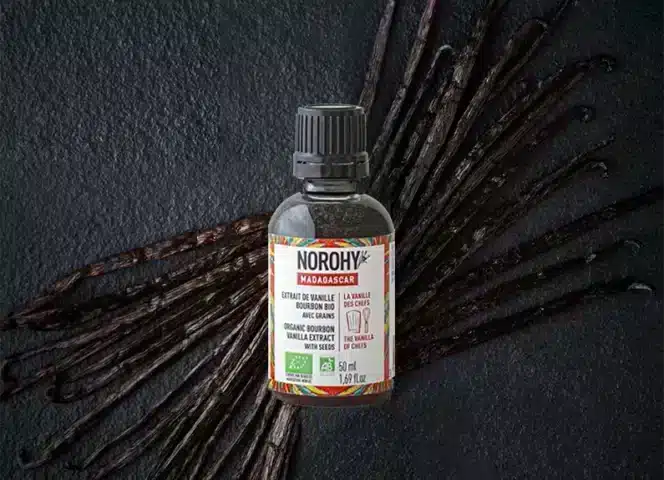
- Norohy is the only company in the market to guarantee the vanillin content in every bottle of extract. Its extracts are Clean Label: vanilla + organic cane sugar syrup, with no additives, artificial colors, or flavor enhancers.
Behind the word “vanilla” on a label lie very different realities: a pod that has undergone a lengthy preparation process, a natural vanilla extract, a natural vanilla flavor obtained through biofermentation, or a simple synthetic vanilla flavor derived from petrochemicals. This guide reviews the five sources of vanilla flavoring, European regulations, and the practical challenges faced by an artisan who wants to make the right choices.
What European regulations say about vanilla flavoring
Legal Framework: Regulation (EC) No. 1334/2008, supplemented by Decree No. 66-319. Five distinct entries:
“Vanilla” or “natural vanilla.” Reserved for the raw product (pods, pod powder). The strictest and most prestigious designation.
“Vanilla extract.” Macerating pods in water and ethanol. The second most authentic option.
“Natural vanilla flavor.” At least 95% of the aromatic fraction must come from vanilla beans.
“Natural flavor” (without “vanilla”). A natural process, derived from plants, but not necessarily from vanilla. This is where biotechnologically produced vanillin falls into this category.
“Flavoring” or “vanilla flavoring.” Synthetic. Petrochemical vanillin or ex-lignin.
A vanilla flavoring containing synthetic vanillin can never be labeled as a “natural flavoring.” The DGCCRF strongly reiterates this point.
Why the gap in aromatic quality is unbridgeable
A vanilla bean contains over 200 aromatic compounds. A natural vanilla extract preserves most of them. Synthetic vanillin = a single molecule. It has a direct, one-dimensional vanilla note, lacking depth and any evolution on the palate.
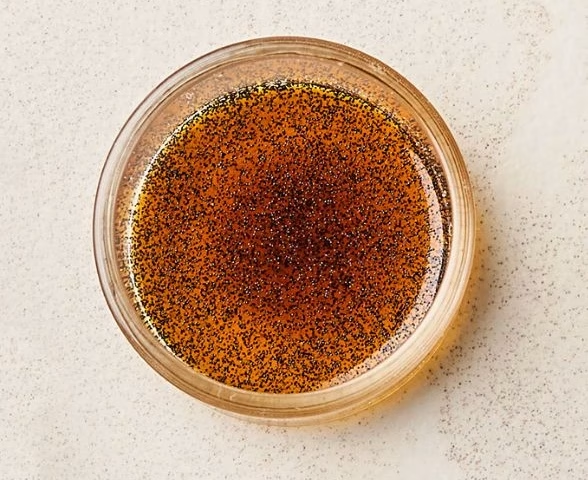
For an artisan, this difference is immediately noticeable on the palate and visible to the naked eye in the black grains of the vanilla caviar. It is also what distinguishes an exceptional dessert from a mass-produced product in the eyes of the end customer. To identify what the pod brings to the table: the aromatic profiles of vanilla.
An increasingly important business issue
Clean label. Consumers read labels. “Organic Bourbon vanilla beans from Madagascar” or “organic Bourbon vanilla extract” immediately stand out from “flavoring.” Norohy extract takes this concept to the extreme: its ingredient list contains only vanilla and organic cane sugar syrup.
Origin and Traceability. Mentioning the region (Maroantsetra, Tahaa) turns an ingredient into a selling point. Norohy is the only company that guarantees traceability all the way back to the village of production, as validated by B Corp certification and organic audits. Details: Norohy’s commitments.
Differentiation from the industry. The food industry makes extensive use of synthetic vanillin. An artisan who uses real vanilla extract or natural vanilla beans objectively stands out from the crowd.
Frequently Asked Questions
What is the difference between vanilla extract and vanilla flavoring? Vanilla extract is obtained by macerating vanilla beans and contains over 200 aromatic compounds. Vanilla flavoring (without any qualifiers) is isolated synthetic vanillin.
Is synthetic vanillin dangerous? No, it is chemically identical to natural vanillin, and its safety has been established. The debate is about quality: a single molecule versus 200+ compounds.
Does a “natural flavor” yogurt contain real vanilla? Not necessarily. “Natural flavor” without “vanilla” allows for sources other than vanilla. Only “natural vanilla flavor” guarantees ≥95% pods.
Can I write “vanilla” on my menu if I use a natural flavor? No. “Vanilla” is reserved for the raw product. Specify the exact source.
Discover Norohy’s natural vanilla products
→ Organic Bourbon vanilla beans from Madagascar
→ Organic Bourbon vanilla extract (guaranteed vanillin content in every bottle, Clean Label)
→ Vanifusion Organic Madagascar Paste and Vanifusion Tahitensis Paste
→ Tadoka, just the right amount of vanilla
Complete Line of Pods — Derivative Products — Vanilla Extracts