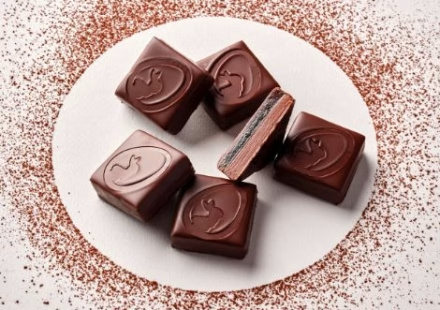
"Oriental tea and rice" bonbon chocolate
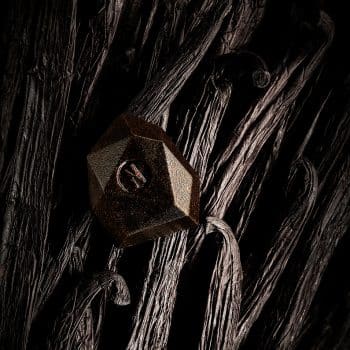
Discover "Oriental tea and rice" chocolate bonbon by Chinese chef Su Yang, made with Norohy vanilla !
Download the recipe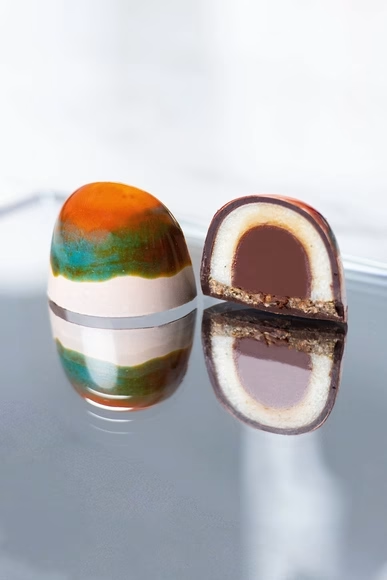
Concentrated vanilla rice milk
- Tahitian vanilla beans 2g
- Unsweetened soy milk 60g
- Glutinous rice leaves 1g
- Raw rice 4g
Heat glutinous rice leaves with unsweetened soy milk to 80°C.
Let steep for 20 minutes to extract the glutinous rice aroma, then strain out the leaves.
Grind 3g of raw rice into small granules, add them to the soy milk from step 1 along with 2g of vanilla bean.
Let steep for 30 minutes, then stir slowly over low heat until the mixture thickens into a paste.
Strain to get 38g of concentrated rice milk for later use.
Vanilla soy milk and rice ganache
- Concentrated vanilla rice milk 40g
- Glucose syrup 1,5g
- Sorbitol 1,5g
- VALRHONA OPALYS white chocolate 33% 50g
- VALRHONA cocoa butter 5g
Make the concentrated vanilla rice milk.
Heat the sugars with the concentrated rice milk.
Add melted white chocolate and cocoa butter.
Then homogenize to emulsify.
Sour honey dark chocolate ganache
- Light cream 11g
- Tahitian vanilla beans 1pc
- Yunnan wild sour honey 6g
- Tréhalose 2g
- VALRHONA MANJARI dark chocolate 64% 20g
Heat vanilla bean with light cream to 80°C, strain out the vanilla bean.
Then, add sour honey and trehalose, and stir well.
Add melted dark chocolate and homogenize to emulsify.
Pipe this ganache into the center of the first layer, ensuring the first layer fully encloses the second layer.
Seaweed brown rice milk chocolate crisp layer
- Brown rice 6g
- Seaweed (nori) 1g
- VALRHONA JIVARA milk chocolate 40% 20g
- Tadoka: the perfect amount of vanilla 1
- VALRHONA cocoa butter 4g
Stir-fry cooked brown rice with seaweed over low heat for 1 minute, then crush into small particles with a food processor.
Melt milk chocolate, TADOKA Vanilla , and cocoa butter, then cool the mixture to 30°C.
Mix the brown rice-seaweed particles from step 1 with the mixture from step 2, stirring evenly.
Pour the mixture into the mold and gently shake to ensure even distribution.
Cocoa butter coloring spray
Prepare dark orange and bright cyan cocoa butter, temper them for later use.
Drop 2 drops of orange cocoa butter into the center of the mold and 1 drop of cyan cocoa butter on the side; gently shake the mold to blend the cocoa butter.
Use an airbrush with low air pressure to spray the cocoa butter from the center outward, ensuring the color is evenly distributed on the mold.
Bonbon shell
Melt Amazonia Republica Del Cacao 75% Dark Chocolate and temper it to 32°C.
Pour the tempered chocolate into the mold and tap to release air bubbles.
Pour out any excess chocolate to form a bonbon shell of appropriate thickness.
Assembly
Layer 1: Vanilla soy milk & rice ganache
Layer 2: Yunnan sour honey dark chocolate ganache
Layer 3: Seaweed brown rice milk chocolate crisp layer
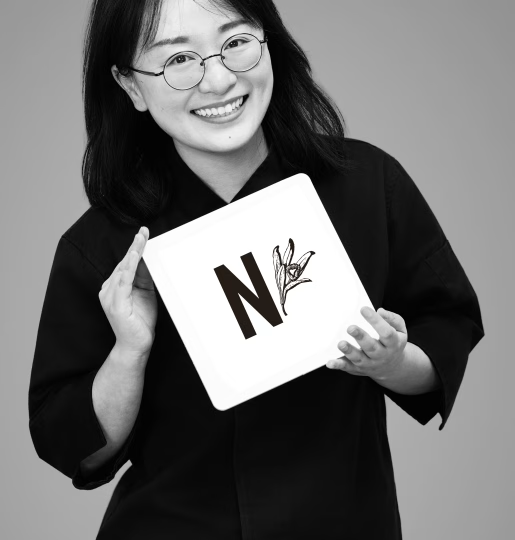
Su YANG
ChocolatièreEn Chine, le chocolat fabriqué avec du vrai beurre de cacao naturel était difficile à trouver. Ce n’est qu’en primaire que Su Yang a goûté chez un camarade de classe, un bonbon au chocolat de l’étranger. Son goût était unique, doux, moelleux, avec une coque en chocolat et un intérieur brun qui s’étirait en petits fils (probablement du caramel). Une seule bouchée suffit pour rêver d’en goûter à nouveau. Su Yang a initialement étudié la pâtisserie française à la Flore Pastry School de Shenzhen. Son enseignante, française, était diplômée du Cordon Bleu Japon. Suite à ce cours, la confection de bonbons s’est avérée être sa partie préférée. Cependant, en Chine les cours spécialisés sur les bonbons étant rares, Su Yang est en grande partie autodidacte. Issue d’un milieu musical, Su Yang a travaillé dans divers domaines liés à la musique—enseignement, planification d’émissions de radio musicales, et journalisme musical—jusqu’à ses 30 ans. Ensuite, elle a changé de secteur pour rejoindre celui de l’assurance : un défi majeur pour un passionné d’art. Pendant son temps libre, il s’est mis à expérimenter la pâtisserie française. La pandémie lui a permis de renouer avec le chocolat, ouvrant sa boutique de bonbons. Su Yang trouve l’inspiration partout : un repas délicieux, un bon café ou un grand vin, un voyage, un marché local ou dans de nombreux éléments chinois. Ainsi, le design de ses bonbons est inspiré de la «transformation de la glaçure du four (Yao Bian)» utilisée dans la porcelaine chinoise ancienne. Cette technique provoque des changements de couleur incontrôlables lors de la cuisson céramique. Su utilise ainsi la technique du «motif soufflé» dans la pulvérisation des bonbons pour un effet chromatique similaire à celui de la glaçure du four donnant un caractère unique à chaque bonbon. Elle adore la gousse de vanille Tahitensis pour sa chair charnue et son arôme unique. Associée au chocolat blanc, cet arôme révèle une douceur riche. Combinée au chocolat noir, elle se transforme en un parfum élégant, boisé et proche de l’amande.